Highlights:
- The sticky inflation this time is a result of past excessive quantitative easing, rising commodity prices, higher labour wages, combined with supply-side pressure brought by de-globalization. This is a structural inflation that the Fed may find difficult to clamp down on with rate hikes in a short period.
- We believe inflation will be higher for longer and the interest rate will not decrease in 2023. To avoid any serious policy mistakes due to excessive tightening, the Fed may be obliged to raise its inflation target.
- There have been various signs of economic recession already, including the inverted yield curve and the employment data that is not in line with the actual market condition. Such are risks that could affect the interest rate environment next year.
- Investors can focus on US Treasuries, of which we are more bullish on short- to medium-term bonds with tenors of 1 to 5 years, while longer-term bonds still face higher price volatility.
- High investment grade corporate bonds (A-rated or above) are more attractive and suitable for investors looking for extra yield pickup above US Treasuries.
- Global high yield bonds are less attractive as overall uncertainty in Asia is still high, and the bond spreads across Europe and US are likely to be widened during an economic downturn. Investors should take a defensive wait-and-see approach accordingly.
The Fed Has Raised Interest Rate by 425 bps This Year
The market might have anticipated the rate hike cycle since the end of last year, but what might have caught people by surprise was the extent of the rate hikes - seven times in just one year, with a total of 425 bps, making it the sharpest rate hike cycle since early 1980s.
Now, the market has been discussing about when the current rate hike cycle will come to an end. In the November FOMC minutes, the Fed also mentioned the focus should be on terminal rate, rather than the pace.
High inflation is undoubtedly the key reason to justify the Fed's rate hikes in the current cycle, but at what level is the interest rate deemed enough to suppress inflation? Looking back at 1979-1982 when inflation rate was also this high, Fed Chair Volcker raised the fed fund rate to 20% at one point (see Chart 1). While it did slow down the inflation successfully, the unemployment rate increased sharply to over 10%, higher than it was during the Great Depression.
Chart 1: US CPI and Fed Fund Rate
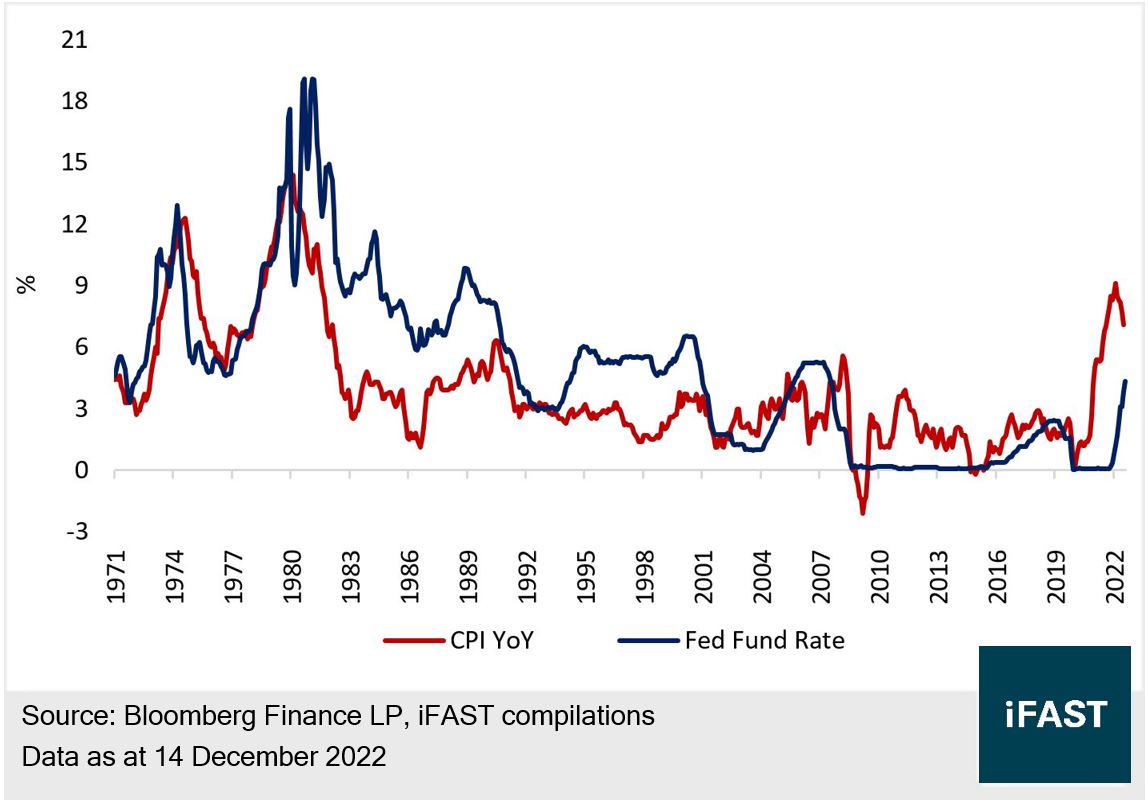
This time the Fed obviously cannot replicate Volcker’s approach, therefore in the absence of precedents, Fed officials can only be ‘controlled’ by the inflation data, leading to a perception that the Fed will continue to hike rates as long as inflation does not slow down.
Inflation Will Be Higher for Longer, but Recession Risk is Also Significant
However, the sticky inflation this time is a result of past excessive quantitative easing, rising commodity prices, higher labour wages, combined with supply-side pressure brought by de-globalization.
In this context, the Fed may find it difficult to clamp down this structural inflation quickly by rate hikes. Moreover, although governments around the world are also raising interest rates, their fiscal policies simply cannot keep up with the tightening monetary policy amid the heightened risks of economic downturn. This will further underpin continuous global inflationary pressure.
Considering that rate hikes have a delayed impact on economy, the Fed may be obliged to raise its 2% inflation target to avoid any serious policy mistakes due to excessive tightening. This will provide a solid ground for them to slow down the pace of rate hikes and prevent the economy from suffering a sharp recession.
In fact, there have been various signs of economic recession already, notably the deeply inverted yield curve. Compared to 12 months ago, the current 10-year and 2-year bond yields are not only inverted, the inversion has even reached 70 bps. Meanwhile, the inversion of 10-year and 1-year bond yields has also reached an astonishing 115 bps (see Chart 2).
Chart 2: US Treasury Yield Curve
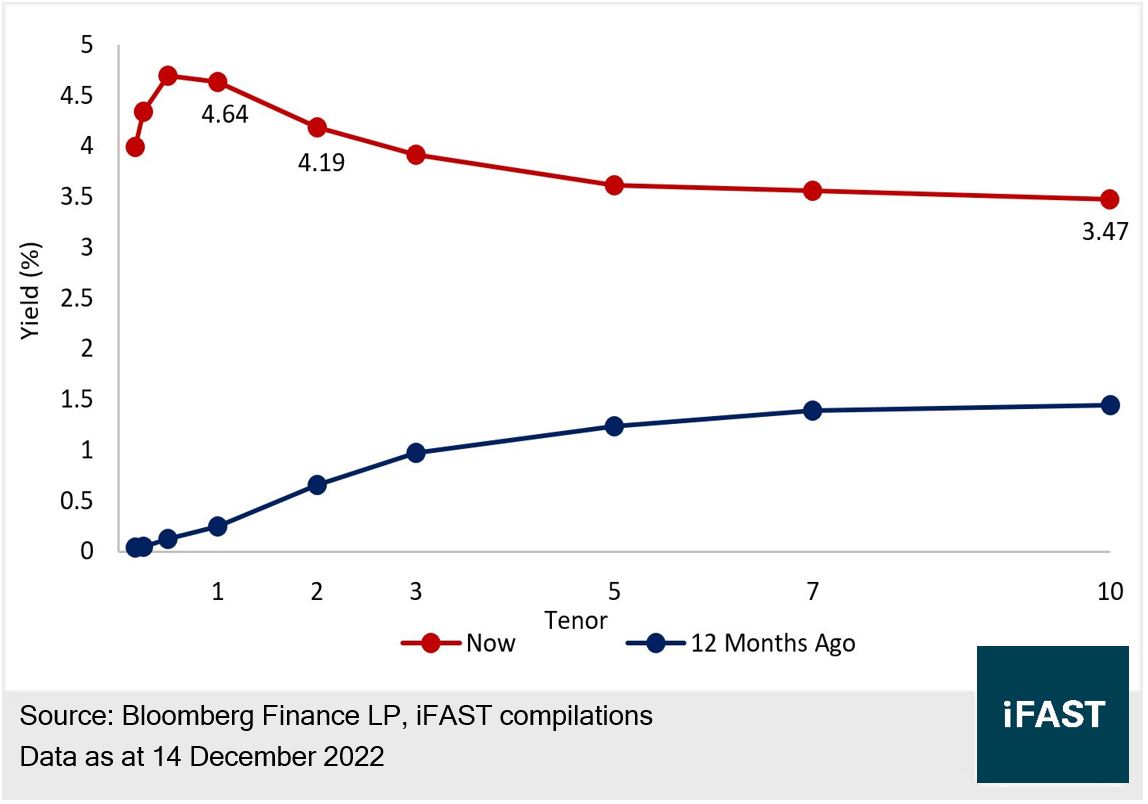
On the other hand, although the US employment data looks resilient, the actual market situation is somewhat different, as there are announcements of layoffs and hiring freezes by large corporations every month. In addition, between March and November this year, the Establishment Survey (based on payroll data) added 2.7 million more jobs than the Household Survey (based on actual sampling). This shows that market conditions may not be as optimistic as expected.
Even though the Q3 GDP has rebounded, other data including property prices, corporate earnings, consumer spending and manufacturing PMI are showing signs of deterioration. We believe the recession risk in US is significant and could affect the interest rate environment in 2023.
Investment Theme: Stay Focus on Short- to Medium-term US Treasuries
Balancing inflation and economic considerations, the Fed recently implied that they would like to slow down the pace of rate hikes, while increasing the terminal rate at the same time. Given the current market environment, we expect the Fed will not lower interest rate in 2023.
Therefore, we believe US Treasuries should remain attractive next year and investors can stay focus on them. Taking the deeply inverted yield curve into account, we are more bullish on short- to medium-term bonds with tenors of 1 to 5 years, which are suitable for investors seeking stable and decent returns (see Table 1). Meanwhile, longer-term bonds will continue to face higher price volatility.
Table 1: US Treasury Yields
Tenor | Indicative Yield to Maturity |
6-month | 4.7% |
1-year | 4.6% |
2-year | 4.2% |
3-year | 3.9% |
5-year | 3.6% |
7-year | 3.6% |
10-year | 3.5% |
Source: Bloomberg Finance LP Data as at 14 December 2022 | |
Investment Theme: High Investment Grade Bonds with A-rated or above are More Attractive
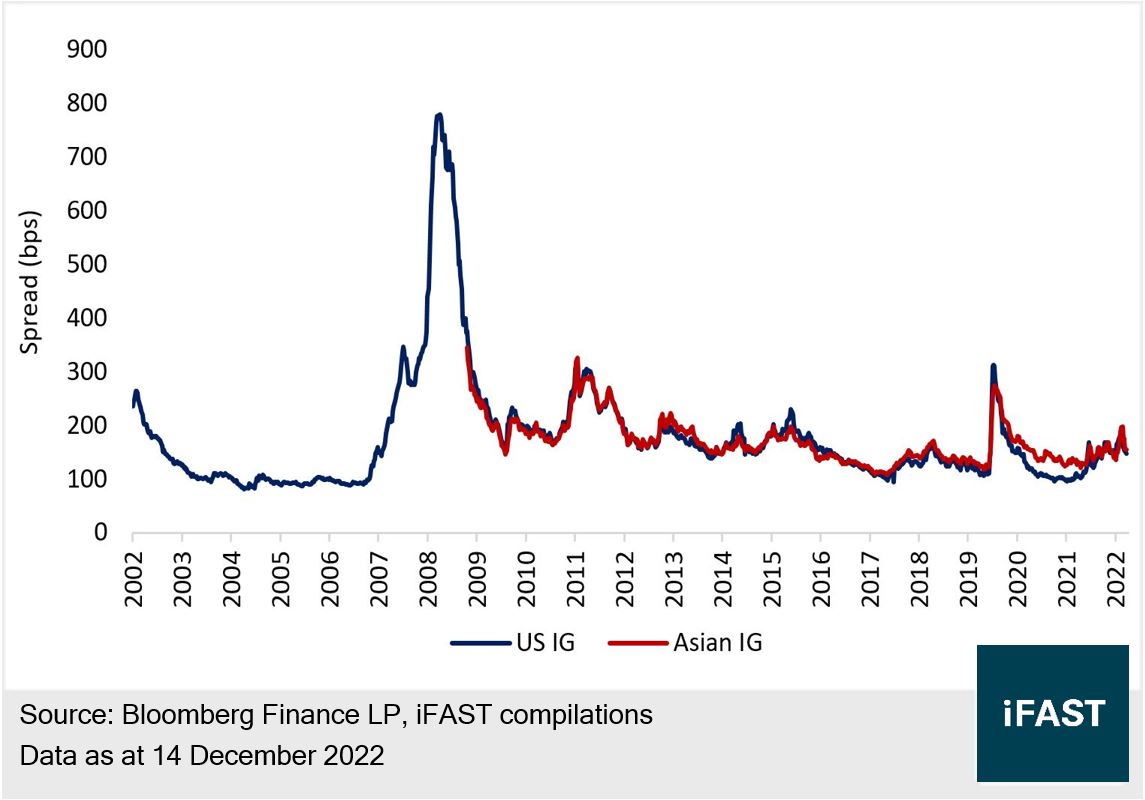
From the perspective of yield spreads, the current spreads of US and Asian investment grade corporate bonds are 150 and 160 bps respectively, which are relatively low in terms of historical levels (see Chart 3).
Looking back at several economic crises including 2008 global financial crisis, 2011 European debt crisis and 2020 COVID pandemic, the current spread level cannot significantly reflect the risks of another global economic recession.
Chart 3: US and Asian Investment Grade Corporate Bond Spreads
Therefore, we believe the high investment grade corporate bonds (A-rated or above) are more attractive as their yield spread stability is much higher than other low investment grade bonds (BBB-rated) during the occurrence of any systematic risks.
A-rated or above bonds are currently offering spreads of around 20 to 150 bps. Such bonds serve as a decent choice for investors looking for extra yield pickup above US Treasuries.
Investment Theme: High Yield Bonds Look Less Appealing
For Asian high yield bonds, although India becomes the country with highest exposure, the overall uncertainty is still high as it is restrained by the debt crisis across different industries in China. Take Chinese real estate sector as example, in spite of the new ’16-point plan’ announced by the Mainland regulators that is essentially a strong package, only a handful of non-defaulting developers can really benefit from it, as their stock and bond prices rebounded sharply. However, the vast majority of defaulted bonds with prices as low as single digits have yet to see a turnaround.
Despite the government's strong determination to rescue the sector, the ultimate problem is still who will bear the losses. Without rebuilding fundamentals such as sales, housing price and land buying, the developers might stay afloat for now but not sustain until the end.
Therefore, we believe that investors should continue to take a defensive wait-and-see approach and be more cautious in selecting such bonds. It is also important to understand the volatility before investments.
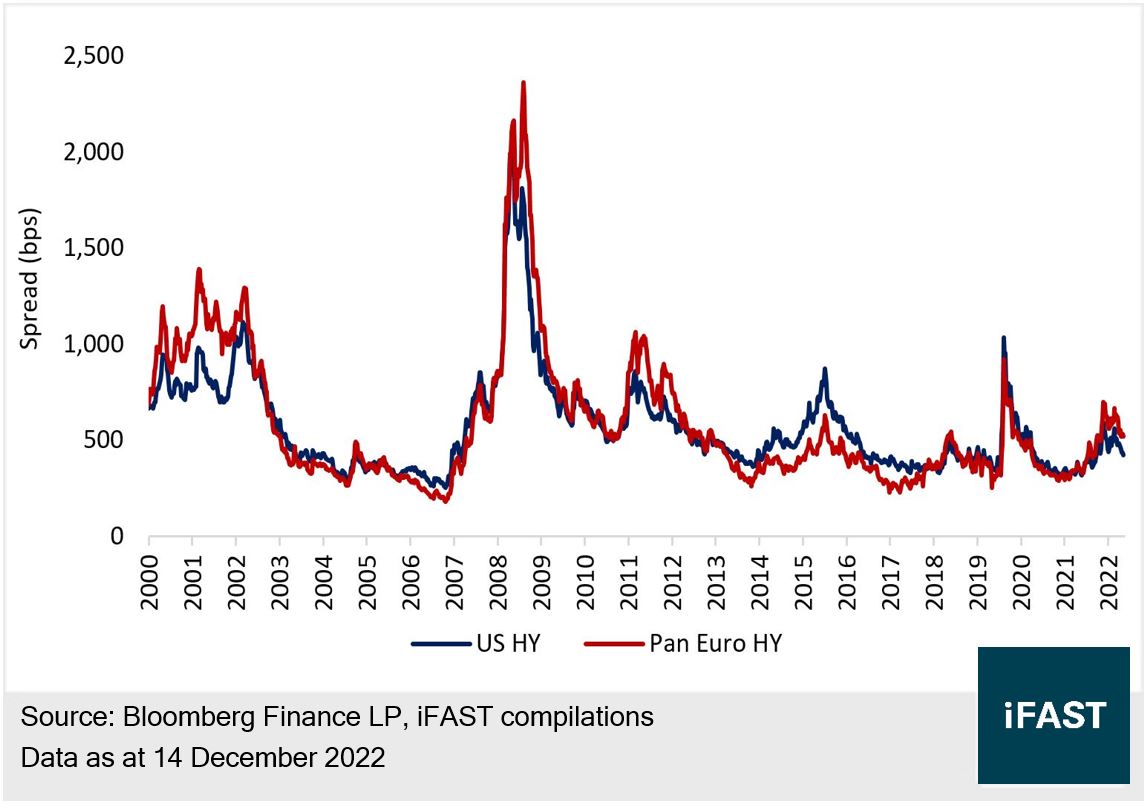
For the European and US markets, European high yield bonds in particular are looking more attractive at the current spread level (see Chart 4). However, similar to the abovementioned risks faced by investment grade corporate bonds, overall spreads may further widen in a recessionary context, given that European countries are currently facing more severe inflation and other economic issues compared to the US.
Chart 4: European and US High Yield Bond Spreads
Conclusion
The sticky inflation this time is a result of past excessive quantitative easing, rising commodity prices, higher labour wages, combined with supply-side pressure brought by de-globalization. This is a structural inflation that the Fed may find difficult to clamp down on with rate hikes in a short period.
We believe inflation will be higher for longer and the interest rate will not decrease in 2023. To avoid any serious policy mistakes due to excessive tightening, the Fed may be obliged to raise its inflation target. There have been various signs of economic recession already, including the inverted yield curve and the employment data that is not in line with the actual market condition. Such are risks that could affect the interest rate environment next year.
Investors can focus on US Treasuries, of which we are more bullish on short- to medium-term bonds with tenors of 1 to 5 years, while longer-term bonds still face higher price volatility. High investment grade corporate bonds (A-rated or above) are more attractive and suitable for investors looking for extra yield pickup above US Treasuries.
Global high yield bonds are less attractive as overall uncertainty in Asia is still high, and the bond spreads across Europe and US are likely to be widened during an economic downturn. Investors should take a defensive wait-and-see approach accordingly.
Our podcast series, Yield Hunters, is available on Spotify, iTunes Podcasts and Google Podcasts. We share our thoughts on new bond issues and hold discussions on the fixed income space. Listen to our latest episode below and follow us!